
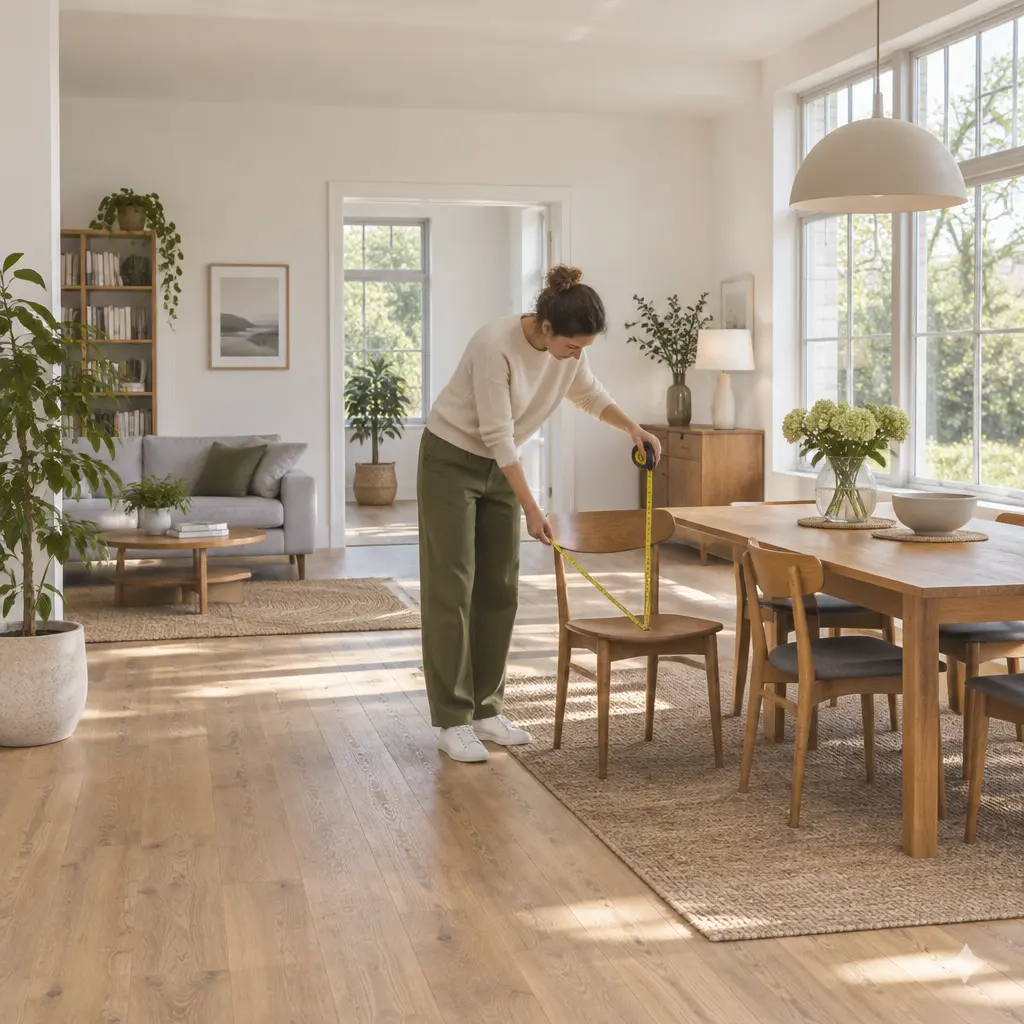
Furniture that fits you perfectly is furniture whose dimensions, support, and layout suit the people who use it and the room it occupies. That fit is a quiet form of luxury: it can make sitting, working, sleeping, and moving through a home more comfortable without relying on conspicuous labels or decoration. Ergonomics research and guidance from organizations such as the U.S. Occupational Safety and Health Administration (OSHA) show why fit matters: posture and work-surface setup influence comfort, while the U.S. Environmental Protection Agency (EPA) estimates that Americans spend about 90% of their time indoors. This guide explains what personal furniture fit means, how to measure for it, how custom and adjustable pieces compare, and how to make thoughtful choices that balance comfort, accessibility, durability, and cost.
Furniture Fit Connects Ergonomics, Proportion, and Everyday Comfort
Furniture fit is the relationship between a person’s body and needs, a piece’s dimensions and support, and the space around it. There is no single ideal chair height or sofa depth for everyone: fit depends on body proportions, intended activity, mobility, and personal preference. The Cornell University Ergonomics Web describes ergonomics as the study of designing work to fit people, rather than requiring people to adapt to poorly designed work. The same principle applies at home.
Fit has several related forms, or hyponyms: anthropometric fit, which concerns body measurements; task fit, which concerns what someone does in the furniture; spatial fit, which concerns circulation and room dimensions; and adaptive fit, which allows settings to change. Together, these explain why a beautiful piece can still feel wrong—and why a modest-looking, well-proportioned one can feel exceptional.
Anthropometric fit: dimensions matched to the body
Anthropometric fit means choosing dimensions in relation to body measurements, such as seated height, leg length, shoulder width, and reach. For a chair, check whether feet can rest securely, the seat supports the thighs without pressing behind the knees, and the backrest meets the body comfortably. These are practical checks, not universal measurements: people with different proportions may need different seat heights or depths.
OSHA’s computer-workstation guidance recommends arranging chairs and work surfaces so users can maintain a neutral, comfortable posture, with feet supported and shoulders relaxed. The principle is useful beyond offices, but household furniture should also be tested in its actual setting. A dining chair that suits a short meal may not provide enough support for hours of reading.
Task fit: furniture shaped around how it is used
Task fit describes how well a piece supports a specific activity. A desk chair, dining chair, reading chair, and lounge chair serve different postures and durations; treating them as interchangeable can lead to discomfort. For a desk, compare chair height, desk height, monitor position, and keyboard reach as one system. For a sofa, consider whether its depth supports an upright seated posture as well as lounging.
The National Institute for Occupational Safety and Health (NIOSH) emphasizes that workstation design should account for both workers and their tasks. At home, that can mean measuring where a laptop, lamp, or book will sit before buying a table. A compact desk may be ideal for brief household tasks but frustrating for someone working remotely every day.
Spatial fit: furniture in proportion to the room
Spatial fit is the match between furniture dimensions and the room’s usable area, including doors, walkways, windows, and other furnishings. Measure the delivery route as well as the intended location: stair turns, lifts, hallways, and door clearances can determine whether a piece can enter the home. On a floor plan, mark the furniture footprint and the paths people need to use.
The U.S. Access Board’s accessibility standards provide specific requirements for accessible routes in covered public and commercial spaces; those requirements are not universal rules for private homes. Still, the broader lesson—preserve clear, usable paths—is valuable in any household, particularly where residents use mobility aids or need extra room to turn and transfer.
Personalized Furniture Fit Improves Comfort and Independence
Personalized furniture fit is the process of selecting, adjusting, or commissioning furniture around a person’s requirements rather than relying only on standard sizing. It can mean a custom-built piece, a chair with adjustable components, or a carefully chosen off-the-shelf design. The defining feature is not price or exclusivity; it is whether the furniture supports the intended user and use.
The World Health Organization’s global report on assistive technology describes assistive products as tools that help people maintain or improve functioning and independence. Although ordinary furniture is not necessarily an assistive product, the report reinforces the importance of designing environments around people’s capabilities. A well-fitted chair, bed, or table can make routine activities easier, especially when needs change with age, injury, or disability.
Adjustable furniture: flexibility without a custom build
Adjustable furniture lets users change dimensions or support, commonly through seat height, desk height, backrest angle, or armrest position. It can be a practical option for shared households, growing children, and people whose preferred posture varies. When evaluating an adjustable desk or chair, check the full adjustment range—not just the advertised feature—and make sure the settings work together for the person who will use it.
The U.S. Consumer Product Safety Commission (CPSC) provides safety guidance for furniture such as clothing storage units, including anchoring tall, unstable furniture to reduce tip-over risks. Adjustability should therefore be paired with stability: inspect locking mechanisms, follow installation instructions, and secure products where appropriate. Flexibility is useful only when the furniture remains safe in every intended position.
Custom furniture: tailoring dimensions and details
Custom furniture is designed or modified to meet particular dimensions, functions, or aesthetic requirements. A maker might alter a dining-table height, shorten a sofa seat depth, add storage, or build a desk around an awkward alcove. Before commissioning a piece, provide measurements, describe how it will be used, and ask for drawings or a prototype where feasible. Confirm delivery access, materials, finish, lead time, and the process for correcting a mismatch.
Customization can reduce compromises, but it is not automatically superior. A standard piece may fit perfectly after careful testing, while a custom piece can miss the mark if measurements or expectations are vague. The most useful brief combines body-related needs, room dimensions, activities, maintenance preferences, and a realistic budget.
Accessible and aging-friendly furniture
Accessible furniture supports safe, practical use by people with differing mobility, reach, balance, or sensory needs. Depending on the person, useful features may include stable armrests, a supportive seat height, clear transfer space, reachable storage, or a table that accommodates a mobility device. These choices should be guided by the user, since needs differ and a feature that helps one person may hinder another.
The U.S. Census Bureau’s American Community Survey tracks disability status and functional difficulties across the population, underscoring that accessibility is relevant to many households, not a niche concern. For individual decisions, an occupational therapist or qualified accessibility professional can assess how furniture interacts with daily activities and the home layout.
Choosing Furniture That Fits Starts with Measurement and Testing
A reliable selection process turns impressions into checks. First identify the user and task, then measure the body-relevant dimensions and room constraints, and finally test the piece in a realistic posture. This sequence connects personal fit to spatial fit and helps prevent expensive delivery-day surprises.
Measure the user, the furniture, and the route
Record the dimensions that matter for the activity: seated height and depth for a chair, working height and knee clearance for a desk, or mattress size and room circulation for a bed. Compare these with product specifications, which may distinguish overall dimensions from usable seat or surface dimensions. Measure doorways, hallways, stairs, and turns before ordering large items.
A simple visual plan can help. Draw the room to scale or mark the furniture footprint on the floor with painter’s tape. This makes it easier to assess whether a sofa blocks a walkway or whether a desk leaves enough room for a chair to move back. It is a low-cost way to test spatial fit before committing.
Test comfort in the intended position
When possible, sit or work in a piece for more than a brief showroom trial. Check whether the posture feels relaxed, whether support points meet the body, and whether the furniture remains comfortable for the expected duration. For online purchases, review return terms, assembly requirements, and measurements carefully; product photography can obscure scale.
There is no single pressure, softness, or cushion firmness that suits everybody. Comfort is affected by body shape, activity, temperature, and personal preference. Treat reviews as clues rather than proof of fit, and prioritize a return policy or trial period when the purchase is difficult to evaluate remotely.
Balance fit with durability and materials
A well-fitting piece is a better long-term choice when its construction and materials can withstand its use. Consider frame strength, joinery, upholstery performance, repairability, and cleaning needs alongside dimensions. The Federal Trade Commission’s guidance on environmental marketing claims also offers a useful reminder: evaluate specific, substantiated claims rather than relying on broad labels such as “green” without details.
Durability matters to household value because a piece that remains useful and repairable may avoid premature replacement. The European Environment Agency’s work on circular economy and textiles highlights the environmental consequences of resource use and waste; while furniture is a distinct product category, the general case for longer-lasting, repairable goods applies. Choose materials and finishes that suit the home’s real maintenance conditions.
The Quiet Luxury of Fit Is Practical, Personal, and Lasting
Furniture that fits combines anthropometric comfort, task suitability, room proportion, and—where needed—adjustability or accessibility. The key distinction is between furniture that merely looks right and furniture that supports the way people actually live. Research and guidance from OSHA, NIOSH, the WHO, and public accessibility agencies all point toward the value of environments designed around human needs, while exact choices remain personal.
Before your next purchase, write down the task, measure both the user and the space, test the piece if possible, and verify delivery and return conditions. If mobility or health needs are involved, invite the person who will use the furniture into the decision and consider professional advice. The result may not announce itself as luxury—but comfort, ease, and lasting usefulness are compelling forms of it.
Sources: Cornell University Ergonomics Web, Ergonomics and Human Factors, https://ergo.human.cornell.edu/; U.S. Occupational Safety and Health Administration, Computer Workstations eTool, https://www.osha.gov/etools/computer-workstations; U.S. Environmental Protection Agency, Indoor Air Quality, https://www.epa.gov/report-environment/indoor-air-quality; National Institute for Occupational Safety and Health, Elements of Ergonomics Programs, https://www.cdc.gov/niosh/docs/97-117/; U.S. Access Board, Guide to the ADA Accessibility Standards, https://www.access-board.gov/ada/guides/; World Health Organization, Global Report on Assistive Technology, 2022, https://www.who.int/publications/i/item/9789240049451; U.S. Consumer Product Safety Commission, Anchor It! Tip-Over Prevention, https://www.cpsc.gov/Safety-Education/Safety-Education-Centers/Anchor-It; U.S. Census Bureau, American Community Survey, https://www.census.gov/programs-surveys/acs; Federal Trade Commission, Guides for the Use of Environmental Marketing Claims, https://www.ftc.gov/legal-library/browse/rules/green-guides; European Environment Agency, Circular Economy and Textiles, https://www.eea.europa.eu/en/topics/in-depth/textiles.