
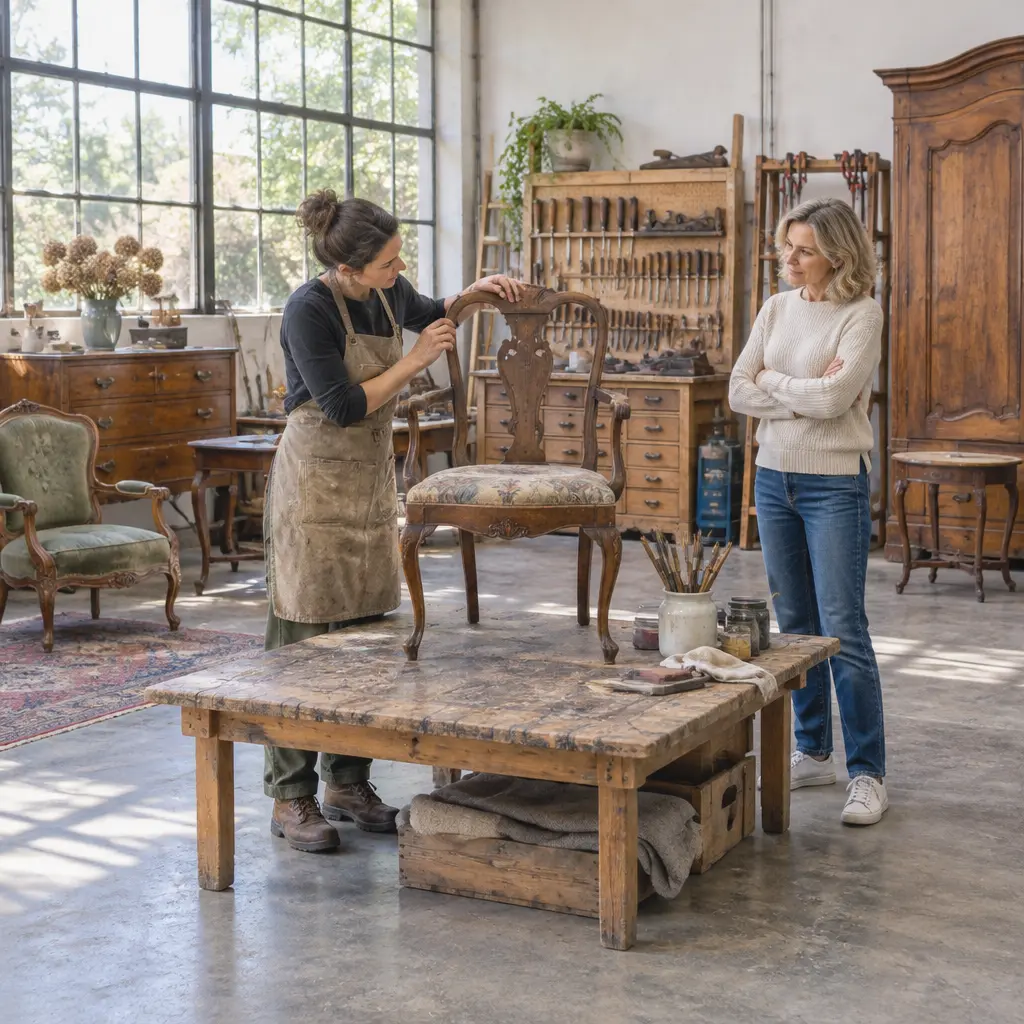
Heirloom furniture and household objects can often be repaired, but deciding whether to renovate or replace them means balancing condition, safety, cost, historical value, and personal meaning. Renovation preserves original material and character; replacement may be more practical when an item is unsafe, irreparable, or poorly suited to its intended use. The strongest decision combines a qualified condition assessment with comparable repair and replacement estimates, while accounting for conservation principles and the environmental cost of new production.
Renovation Versus Replacement: A Decision Framework for Heirloom Pieces
A renovation-versus-replacement decision framework is a structured way to determine whether an heirloom should be repaired, conserved, adapted, or replaced. There is no universal rule that an older object should always be saved: the right choice depends on its significance, condition, safety, function, and the owner’s resources. The American Institute for Conservation advises that conservation decisions should respect an object’s cultural significance and preserve as much original material as possible. Meanwhile, the U.S. Environmental Protection Agency reports that 12.1 million tons of furniture and furnishings entered U.S. municipal solid waste in 2018, underscoring the waste implications of routine replacement. A careful assessment can therefore protect family history, avoid unnecessary waste, and prevent spending heavily on an item that cannot meet essential needs.
How Heirloom Significance Shapes Renovation Versus Replacement
An heirloom is an object passed down through generations, typically valued for personal, cultural, historical, or material reasons. The Smithsonian’s Museum Conservation Institute describes conservation as the examination, documentation, treatment, and preventive care of cultural property. That approach is useful beyond museums: it begins by understanding what an object is, what makes it meaningful, and what changes could diminish its significance. “Heirloom” can describe furniture, textiles, jewelry, clocks, instruments, ceramics, or tools, and each category calls for different expertise and standards of care.
Sentimental and Family Significance
Sentimental significance is the personal value created by family stories, use, association, or inheritance. A dining table where generations gathered may warrant a different decision from an otherwise similar table with no known history. Record the object’s provenance—its known ownership and history—along with family recollections and photographs before work begins. This documentation can help guide treatment and preserve information even if the piece later requires substantial repair.
Historical, Cultural, and Craft Significance
Historical or cultural significance concerns an object’s connection to a period, community, maker, or important event. Craft significance may lie in hand-cut joinery, original finishes, distinctive materials, or techniques no longer commonly used. The National Park Service’s preservation guidance emphasizes identifying and retaining character-defining features when treating historic properties. Applied to an heirloom, that principle suggests documenting original components and consulting a specialist before stripping finishes, replacing hardware, or altering construction.
Market Value Versus Meaning
Market value is an estimate of what an object might sell for; it is not a measure of family importance or the cost of replacing its history. If an item may be rare, valuable, or culturally sensitive, seek an independent appraisal or specialist assessment before authorizing work. Avoid using a single online listing as proof of value: condition, authenticity, maker, provenance, and local demand all affect price. A valuable object may require conservation rather than ordinary restoration, while a modestly priced object may still be irreplaceable to its family.
Once significance is understood, the next step is to determine whether the object can be stabilized and safely used. This distinction helps separate cosmetic aging from structural failure and guides whether the appropriate intervention is conservation, restoration, repair, or replacement.
How Condition and Safety Guide the Decision
Condition assessment is a systematic review of an object’s materials, damage, stability, and likely causes of deterioration. The American Institute for Conservation’s professional guidance stresses examination and documentation before treatment. For owners, a useful initial inspection records loose joints, cracks, missing parts, water damage, corrosion, insect activity, odors, and previous repairs. This inspection is not a substitute for a conservator, structural specialist, or hazardous-materials professional when serious problems are present.
Structural Integrity and Usability
Structural integrity means that an object can safely bear its intended loads and withstand ordinary use. A chair with loose joints, a cabinet that tips, or a bed with a cracked rail may need immediate stabilization before anyone uses it. Ask a qualified furniture restorer to distinguish repairable joint failure from extensive wood decay, severe distortion, or damage that would make safe use impractical. For children’s furniture, stairs, seating, and other load-bearing objects, prioritize safety over preserving the object in active service; display or restricted use may be safer alternatives.
Material Damage and Environmental Risks
Material damage includes deterioration such as swelling, splitting, fading, corrosion, mold, or pest damage. The National Park Service’s preservation guidance identifies moisture control as an important part of protecting historic materials. Keep vulnerable items away from leaks, direct sunlight, extreme temperature changes, and persistently damp conditions. If mold, active insect infestation, lead-containing coatings, or other hazardous materials are suspected, do not sand, strip, or disturb the material until an appropriately qualified professional has assessed the risk.
Repairability and Reversibility
Repairability asks whether the damage can be addressed without disproportionate loss of original material or function. Reversibility is the ability to remove or undo an intervention with minimal harm, a principle commonly considered in conservation planning. A discreet, compatible repair may preserve more historical evidence than replacing an entire component. Ask the craftsperson to identify which parts are original, which will be altered, what materials will be introduced, and whether future conservators could recognize or reverse the work.
A sound object can still be a poor candidate for a particular renovation if the proposed work is too costly or changes its character. Comparing treatment options with replacement on equal terms makes the decision more transparent.
How Cost, Function, and Environmental Impact Compare
A useful comparison includes more than the initial invoice. It considers the scope of work, transport, materials, maintenance, expected service life, safety, and the value of retaining original fabric. The EPA’s estimate of 12.1 million tons of furniture and furnishings in the U.S. municipal solid waste stream in 2018 shows that furniture disposal is a substantial waste issue, though it does not mean every old piece is environmentally preferable to every new one. The environmental outcome depends on the repair required, the replacement product, its materials, its durability, and how each item is eventually handled.
Total Cost of Ownership
Total cost of ownership includes the purchase or treatment price plus foreseeable upkeep and related expenses over time. Obtain written estimates that specify labor, materials, replacement parts, finishing, delivery, and contingencies. Compare a targeted repair, a full restoration, and a suitable replacement—not just one repair quote against a discounted new item. If an heirloom’s restoration cost exceeds its likely resale value, that alone does not settle the question; family significance and expected use may justify the expense, while a strict budget may favor stabilization or display instead.
Function, Accessibility, and Household Needs
Functional suitability is the degree to which an object meets present needs for comfort, size, access, and daily use. A family may preserve a dresser’s original structure while adapting drawer pulls for easier access, or keep a fragile table for display rather than everyday meals. Discuss proposed modifications with a specialist when they could affect historic character, safety, or value. If the piece cannot safely perform its intended role, consider whether another role—such as display, occasional use, or a documented family archive—can keep it meaningful.
Waste, Reuse, and Embodied Materials
Repair and reuse can extend the life of existing materials and defer disposal, while replacement introduces the impacts of manufacturing, packaging, and transport. The EPA’s 2018 furniture and furnishings estimate is a useful national benchmark, not a lifecycle comparison of individual repair and replacement choices. Environmental benefit is most plausible when a repair is durable, materials are responsibly sourced, and the item remains useful. If replacement is necessary, consider donating or selling a usable piece, recycling appropriate materials, or salvaging components rather than sending the entire object to landfill.
The evidence can be organized into a practical decision sequence. The following framework helps owners act consistently without treating resale price or age as the only deciding factor.
A Practical Heirloom Renovation or Replacement Framework
Step 1: Document the Object
Photograph the piece from several angles, note dimensions and visible damage, and collect receipts, labels, maker marks, family stories, and earlier photographs. Record what is believed to be original and what may have been changed. Documentation supports estimates, appraisal, insurance, future care, and family decision-making.
Step 2: Identify Immediate Risks
Stop using an item that appears unstable, electrically unsafe, contaminated, or likely to injure someone. Keep it in a dry, secure location and avoid amateur sanding, chemical stripping, or aggressive cleaning until hazards and materials are understood. Seek a qualified professional where structural failure, infestation, mold, or potentially hazardous coatings are involved.
Step 3: Define the Desired Outcome
Decide whether the goal is safe daily use, preservation of original appearance, stabilization, display, or preparation for sale. These goals lead to different treatments. For example, a museum-style conservation treatment may prioritize retaining original evidence, while a functional repair may prioritize dependable everyday use. State the goal clearly when requesting an estimate.
Step 4: Compare Qualified Options
Request itemized proposals from professionals whose experience matches the object’s materials and significance. Compare a minimal stabilization, a targeted repair, a broader restoration, and replacement where appropriate. Ask about treatment methods, expected durability, changes to original material, insurance, schedule, and what may be discovered after work begins. For a potentially significant object, obtain a second opinion before irreversible treatment.
Step 5: Make and Record the Decision
Choose the option that best balances safety, significance, condition, function, cost, and environmental consequences. Record why the decision was made and retain estimates, photographs, and treatment records. If replacement is chosen, preserve identifying components or documentation when feasible, and consider a safe new use for the original item or its materials.
For example, a century-old family table with stable construction but a worn finish may merit a conservation-minded repair if it remains useful and its original surface matters to the family. A chair with a failed load-bearing rail may require professional structural repair before use; if safe repair is not feasible, retaining it as a display object may be preferable to either unsafe use or immediate disposal. These cases illustrate why significance, condition, and intended use must be considered together.
Conclusion: Preserve What Matters, Replace When Necessary
A reliable renovation-versus-replacement decision begins with the heirloom’s personal and historical significance, then evaluates condition, safety, repairability, function, total cost, and environmental impact. Conservation principles favor thoughtful examination, documentation, and minimal appropriate intervention, but they do not require keeping an unsafe or unusable object in service. The EPA’s furniture-waste estimate reinforces the value of considering repair and reuse before disposal, while each item still deserves an individual assessment. Document the piece, pause use if safety is uncertain, and consult a qualified specialist before irreversible work; these steps help families protect both the object and the story it carries.
Sources: American Institute for Conservation, Code of Ethics and Guidelines for Practice, https://www.culturalheritage.org/about-conservation/code-of-ethics; Smithsonian Museum Conservation Institute, What Is Conservation?, https://mci.si.edu/what-conservation; U.S. Environmental Protection Agency, National Overview: Facts and Figures on Materials, Wastes and Recycling, https://www.epa.gov/facts-and-figures-about-materials-waste-and-recycling/national-overview-facts-and-figures-materials; National Park Service, Preservation Brief 6: Dangers of Abrasive Cleaning to Historic Buildings, https://www.nps.gov/orgs/1739/upload/preservation-brief-06-abrasive-cleaning.pdf; National Park Service, Preservation Brief 39: Holding the Line: Controlling Unwanted Moisture in Historic Buildings, https://www.nps.gov/orgs/1739/upload/preservation-brief-39-controlling-unwanted-moisture.pdf