
Kitchen joinery is the system of cabinets, drawers, doors, shelves, and their connections that makes a kitchen work. Its long-term durability depends less on appearance alone than on the details hidden behind it: moisture-resistant materials, well-supported cabinet boxes, strong joints, correctly fitted hardware, sealed edges, and installation that accommodates walls and floors. The National Kitchen & Bath Association’s planning guidance treats kitchens as high-use spaces requiring careful attention to safety, clearances, and function; meanwhile, cabinet-industry standards address structural performance and finish quality. This guide explains how cabinet construction, joints, moisture control, hardware, and installation details work together—and what homeowners can specify and inspect to reduce premature wear.
Cabinet Construction Defines Kitchen Joinery Durability
Kitchen joinery durability is the ability of cabinet components and their connections to withstand repeated loading, opening and closing, cleaning, and exposure to moisture and heat without losing function or structural integrity. The Kitchen Cabinet Manufacturers Association (KCMA) publishes the ANSI/KCMA A161.1 performance standard, which evaluates cabinet construction through tests that include door operation, drawer loading, shelf loading, and resistance to household substances. The standard is a useful benchmark, but it does not guarantee that every product bearing a quality claim will suit every kitchen condition; buyers should check the product’s actual certification and installation requirements.
The main construction types—face-frame and frameless cabinets—can both be durable when properly designed and installed. More consequential than the label is whether the cabinet box resists racking, whether joints are adequately secured, whether shelves and drawer bottoms are supported for their intended loads, and whether exposed edges are protected from water. These factors connect the cabinet’s material choices to the joints that hold it together.
Cabinet boxes and panel materials
A cabinet box is the structural enclosure made from its sides, top, bottom, back, and any face frame. Common panel materials include plywood, particleboard, and medium-density fiberboard (MDF). Each can perform well in the right application: plywood is built from bonded wood veneers; particleboard uses wood particles and resin; MDF uses refined wood fibers and resin. Material name alone is not a durability rating. Panel thickness, grade, span, fastening method, edge treatment, and exposure to water all matter.
For a long service life, ask the cabinetmaker or manufacturer to identify the box material and thickness, explain how the back is attached, and state the cabinet’s load limits. A securely fitted back helps resist racking—the sideways distortion that can loosen joints or make doors misalign. At sinks and dishwashers, specify a design that limits water reaching vulnerable panel edges, and repair leaks promptly rather than relying on a moisture-resistant label.
Face-frame and frameless cabinet systems
Face-frame cabinets have a solid-wood frame attached to the front of the box; frameless cabinets use the cabinet sides as the primary front structure, with doors mounted directly to them. Face frames can provide a sturdy mounting surface and help keep the front square. Frameless construction offers wider openings and relies heavily on accurate box assembly, strong panel connections, and appropriate hardware. Neither system is inherently maintenance-free: a weak back, poorly secured box, or moisture-damaged edge can undermine either design.
The practical comparison is therefore about construction quality and serviceability. Confirm how cabinets will be fastened to neighboring boxes and the wall, how hinges are mounted, and whether doors and drawers can be adjusted after seasonal movement or settling.
Joinery Methods Strengthen Kitchen Cabinet Connections
Joinery is the method used to connect pieces of wood or manufactured panels. In kitchen cabinets, the relevant forms include mechanical fasteners, glued joints, dowels, dados, rabbets, and, in solid-wood components, frame-and-panel construction. The most durable choice depends on the material, load direction, manufacturing accuracy, and exposure conditions. A well-designed joint distributes force and keeps components aligned; a poorly fitted joint can loosen under repeated drawer use or cabinet loading.
Because joints connect directly to cabinet-box strength, evaluate how the back, bottom, shelves, and face frame or front edges are assembled—not just the visible finish. Ask for construction details in writing, particularly for heavy drawers, wide cabinets, and sink bases.
Dado, rabbet, dowel, and screw connections
A dado is a groove cut across a panel to receive another component, while a rabbet is a step-shaped recess cut along an edge. Both can help locate cabinet parts and increase contact between joined surfaces. Dowels align adjoining pieces and can reinforce an assembly; screws provide clamping force and mechanical attachment. These methods are often combined, with adhesive used where suitable for the materials and manufacturing process.
The name of a joint does not prove its strength. Fit, panel thickness, screw placement, adhesive compatibility, and workmanship determine performance. For example, screws driven too close to a panel edge can cause splitting or breakout, while a shallow or poorly fitted groove may provide little practical support. A cabinet specification should describe the assembly method clearly enough to distinguish a designed joint from a generic claim such as “solid construction.”
Drawer-box joints and bottom support
Drawers experience repeated movement and concentrated loads, making their corners and bottoms especially important. Dovetail joints interlock through angled “tails” and “pins”; other drawer boxes may use dowels, screws, staples, or glued butt joints. Any method can be appropriate when engineered for the expected load, but interlocking corners are a visible sign of a mechanical connection rather than a guarantee of overall drawer quality.
Check the drawer-bottom material, thickness, and how it is captured or fastened. A thin bottom that spans a wide drawer without adequate support may sag even if the corners are strong. KCMA’s cabinet performance testing includes drawer-loading requirements, so certification to the applicable ANSI/KCMA A161.1 edition provides a more meaningful reference than joinery terminology alone. Confirm the cabinetmaker’s stated load limits for unusually heavy items such as cookware or pantry goods.
Moisture Protection Preserves Kitchen Joinery
Moisture protection is the combination of material selection, edge sealing, installation clearances, ventilation, and maintenance that limits water damage to cabinets. Kitchens face spills, steam, plumbing leaks, and repeated cleaning. Water can swell susceptible panel materials, weaken adhesives, lift veneer or laminate, and encourage mold growth when dampness persists. The U.S. Environmental Protection Agency advises that indoor mold growth can generally be prevented by controlling moisture and drying wet materials promptly; this is relevant to cabinets because concealed leaks may remain unnoticed behind a sink base or dishwasher.
Moisture management is not a single coating or “waterproof” product claim. It begins with vulnerable locations and transitions—especially sink bases, dishwasher edges, countertop seams, and flooring interfaces—then pairs protective detailing with quick leak detection and repair.
Sealed edges and sink-base protection
An edge seal is a protective finish or covering applied to an exposed panel edge to reduce water entry. Cabinet doors and boxes may use veneer, laminate, paint, or edge banding, but seams and cutouts remain potential weak points. Under a sink, use a removable protective liner or tray where appropriate, keep plumbing connections accessible, and avoid trapping water against cabinet panels. Seal countertop and backsplash junctions with materials suited to the surface and follow the sealant manufacturer’s maintenance instructions.
The EPA’s moisture guidance emphasizes fixing water problems and drying affected areas rather than simply covering damp materials. If a cabinet base has swollen, softened, or developed persistent odor, identify and correct the source before replacing or enclosing it.
Dishwasher, oven, and heat-adjacent details
Appliance-adjacent detailing protects cabinets from steam, heat, and vibration. A dishwasher can release humid air near a countertop edge; an oven or range can expose nearby finishes to elevated temperatures. Follow appliance installation instructions for clearances, ventilation, mounting, and any required heat shields. Use a protective barrier or edge treatment only when it is compatible with the appliance and countertop manufacturer’s requirements.
Avoid assuming that a standard cabinet finish is suitable for every heat exposure. Confirm the appliance’s specified installation conditions, ensure doors and drawers do not obstruct ventilation, and inspect nearby edges for lifting or discoloration during routine cleaning.
Hardware and Installation Keep Kitchen Joinery Aligned
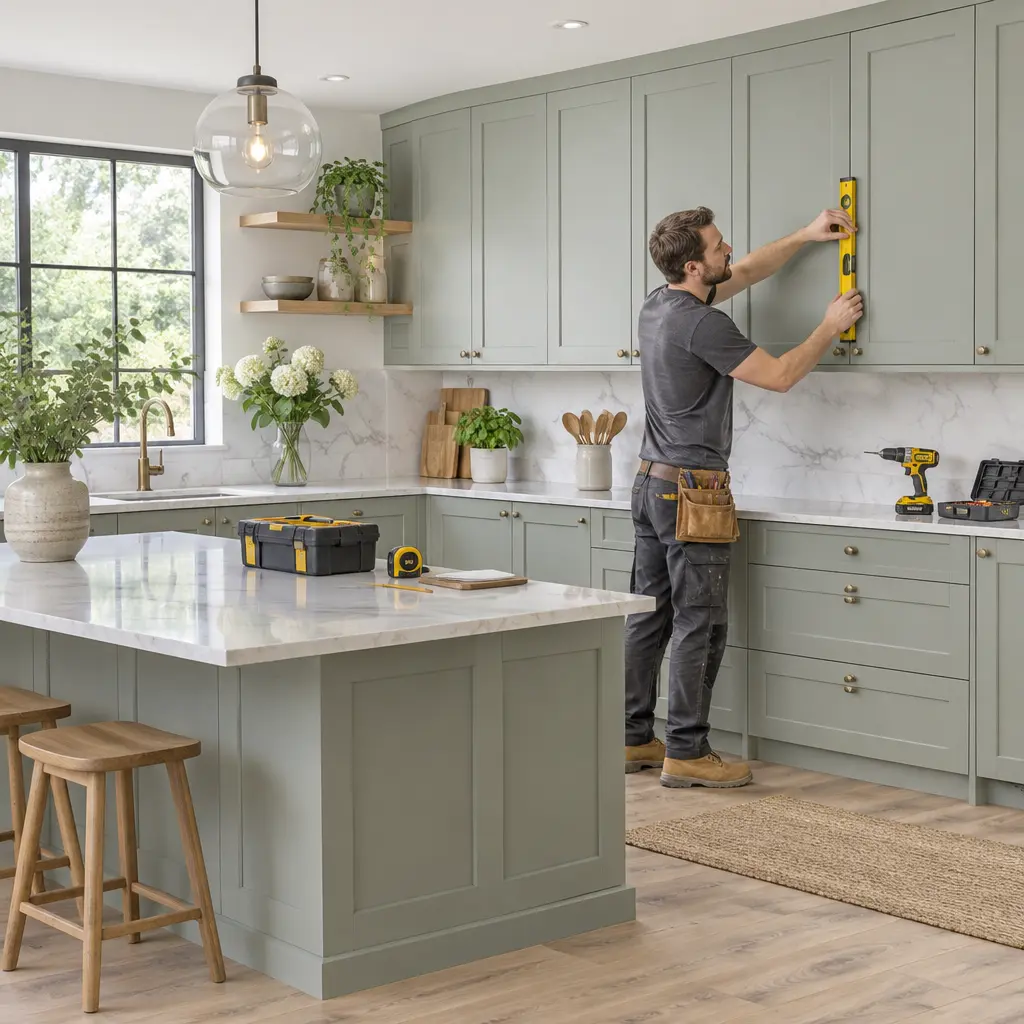
Cabinet hardware includes hinges, drawer slides, pulls, catches, and the fasteners that attach them. Installation quality includes cabinet leveling, secure wall anchoring, accurate alignment, and proper support at seams and openings. These details influence durability because misaligned cabinets place uneven forces on hinges and slides, while loose wall attachment can cause movement or joint failure. The National Kitchen & Bath Association’s kitchen-planning guidance stresses appropriate clearances and functional layouts; accurate installation helps those planned clearances remain usable over time.
Hardware and installation should be considered together. A high-quality slide cannot compensate for a weak drawer box, and a strong cabinet cannot perform well if it is installed out of level or inadequately anchored.
Hinges and drawer slides
Hinges support doors and allow repeated opening, while drawer slides guide and carry drawers as they extend. Relevant specifications include rated load, extension type, adjustment range, corrosion resistance, and suitability for the cabinet’s dimensions. Soft-close mechanisms can reduce slamming, but they do not remove the need to stay within load limits or keep hardware correctly adjusted.
Before purchase, ask for the hardware manufacturer and model, available replacement parts, and the rated capacity for the installed configuration. Check that hinge screws engage sound material and that slides are mounted to straight, parallel cabinet surfaces. Periodic adjustment is normal; persistent sagging, binding, or loose fasteners may indicate an overloaded drawer or an installation problem.
Leveling, anchoring, and cabinet-to-cabinet fastening
Leveling means bringing cabinet runs into a stable, aligned plane despite uneven floors and walls. Installers typically use shims to prevent cabinets from twisting under fastener pressure, then anchor cabinets to suitable wall framing or other approved structural support. Adjacent cabinets should also be clamped and fastened together as specified, with care not to damage finished faces or distort the boxes.
Installation should follow the cabinet and fastener manufacturers’ instructions and comply with local building requirements. Before countertops are installed, verify that cabinet runs are level, joints are tight, appliances fit their openings, and the cabinets are securely attached. This inspection catches alignment issues before they become difficult to correct.
Maintenance and Quality Checks Extend Kitchen Joinery Life
Maintenance is the routine inspection and care that prevents small defects from becoming structural damage. Durable joinery still benefits from prompt spill cleanup, ventilation, sensible loading, and occasional hardware adjustment. Because no single published lifespan applies to every cabinet, service life depends on materials, workmanship, use, moisture exposure, and maintenance. Product certification and warranty terms can help compare options, but they should be read alongside construction specifications and exclusions.
A practical inspection checklist
Inspect cabinets at handover and periodically thereafter. Look for swollen edges, loose fasteners, cracked joints, sagging shelves, drawer-bottom deflection, hinge movement, and water staining beneath plumbing or appliances. Open and close every door and drawer, check that fronts remain aligned, and confirm that adjustable shelves sit securely on their supports.
- Request written material, panel-thickness, hardware, and load-limit specifications.
- Confirm whether the cabinet line is certified to the applicable KCMA/ANSI performance standard, and verify the scope of that certification.
- Inspect sink-base and appliance-adjacent edges for seams that could admit water or heat.
- Keep cabinet surfaces dry, use cleaning products approved for the finish, and repair plumbing leaks promptly.
- Retain installation records, warranty documents, and hardware model information for future adjustment or replacement.
Real-world risk: a concealed sink leak
A slow leak beneath a sink can wet the cabinet floor and exposed panel edges long before water appears on the kitchen floor. The panel may swell, fasteners may lose holding strength, and stored items can conceal the damage. A simple inspection after plumbing work, along with a removable tray and prompt drying, helps reveal the problem early. This example illustrates why durability depends on both construction details and maintenance: even a well-built cabinet is vulnerable to prolonged, unaddressed moisture.
Conclusion: Specify Details That Protect Kitchen Joinery
Long-term kitchen joinery durability comes from a coordinated set of decisions: sound cabinet-box construction, joints suited to their loads, supported drawers and shelves, protected edges, correctly specified hardware, and careful installation. KCMA performance testing offers a useful way to assess cabinet function and strength, while EPA moisture guidance reinforces the importance of preventing and quickly addressing water exposure. No material or decorative joint is a substitute for clear specifications and good workmanship.
When planning a kitchen, ask manufacturers and installers for construction details, certification evidence, hardware ratings, and maintenance instructions. Inspect vulnerable areas regularly and deal with leaks or alignment problems early. These practical steps help protect both the investment and the everyday function of the kitchen.
Sources: Kitchen Cabinet Manufacturers Association, ANSI/KCMA A161.1 Performance and Construction Standard for Kitchen and Vanity Cabinets, https://kcma.org/; U.S. Environmental Protection Agency, A Brief Guide to Mold, Moisture and Your Home, https://www.epa.gov/mold/brief-guide-mold-moisture-and-your-home; National Kitchen & Bath Association, Kitchen Planning Guidelines, https://nkba.org/planning-guidelines/