
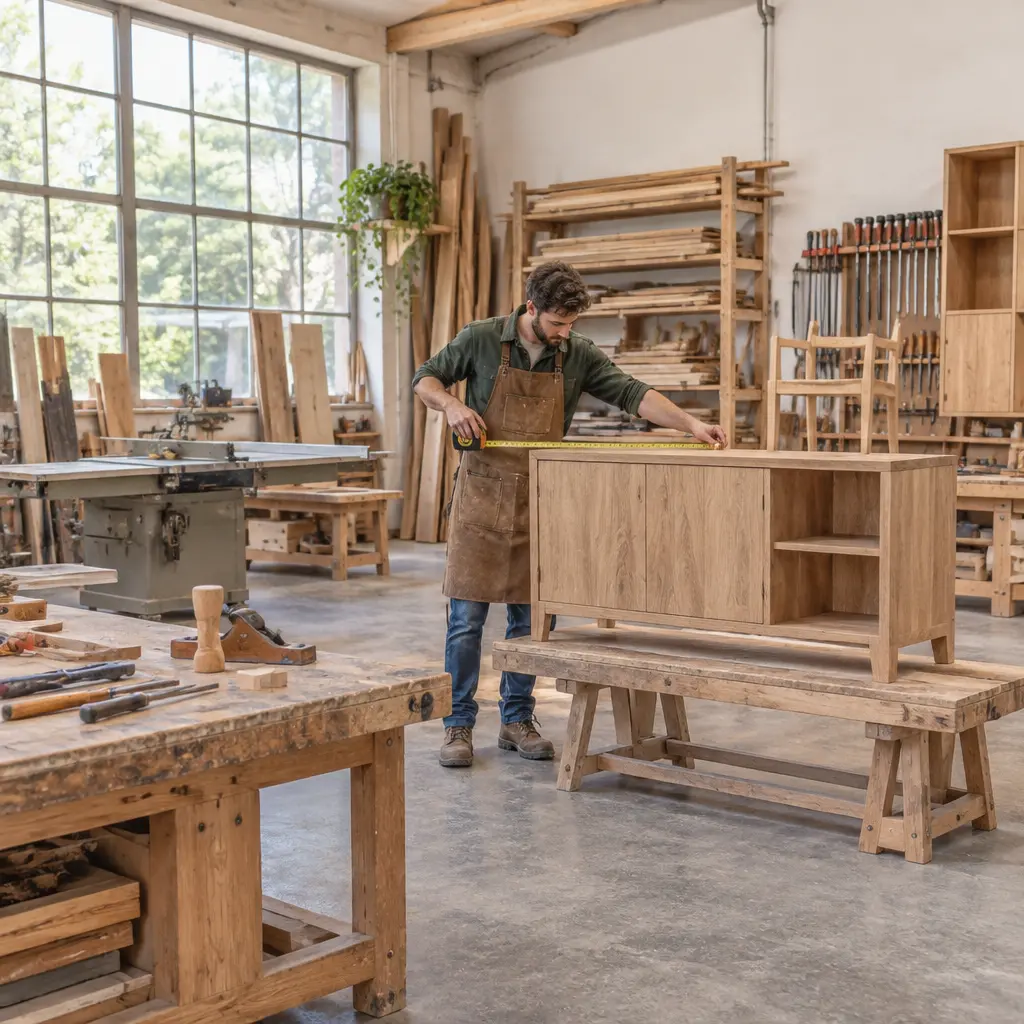
Bespoke furniture is furniture designed and made to a particular client’s requirements rather than selected as a standard, ready-made product. Its price pays not only for materials, but also for design decisions, skilled labor, fitting, finishing, and the time needed to make an individual piece. Those costs matter in a market where the U.S. Bureau of Labor Statistics’ Consumer Expenditure Survey tracks furniture and bedding as a distinct household spending category, while the U.S. Environmental Protection Agency estimates that 12.1 million tons of furniture and furnishings entered the U.S. municipal solid-waste stream in 2018. Understanding the difference between customization, craftsmanship, materials, and service helps buyers judge what a bespoke quote actually includes—and whether the piece is likely to serve them well over time.
Bespoke furniture pricing reflects design, labor, and fit
“Bespoke” generally means made specifically to a customer’s order. In furniture, that can range from adjusting the dimensions of an existing design to developing a one-off piece from an original brief. Unlike mass-produced furniture, which spreads design, setup, and production costs across many units, a bespoke commission allocates those costs to one project. The price therefore reflects both tangible inputs and the work required to turn a particular need into a finished object.
A useful way to read a quote is to separate its main cost drivers: design and specification, materials, workshop labor, specialist processes, delivery and installation, and business overhead. A high price does not automatically prove superior quality; buyers should ask what is included and how the maker will verify fit, finish, and performance.
Design work turns a brief into a buildable piece
Design work is the process of translating a client’s requirements—such as room dimensions, storage needs, preferred appearance, and budget—into drawings, measurements, and construction details. Depending on the commission, the maker may produce sketches, measured plans, material samples, or technical drawings before fabrication begins. The more unfamiliar or complex the brief, the more time may be needed to resolve proportions, structure, and practical details.
This stage can include site visits and revisions. A built-in cabinet, for example, may need to accommodate uneven walls, pipes, electrical outlets, or existing trim. Those measurements and design decisions are part of the product’s value because they reduce the risk of a poor fit. Buyers should clarify how many design revisions are included and whether drawings remain with them if they do not proceed.
Customization adds value through fit and function
Customization means adapting a design to a particular person, space, or use. It may involve nonstandard dimensions, a special finish, different storage arrangements, or details that coordinate with existing architecture. This is one of the clearest distinctions between bespoke furniture and a standard item: the piece can respond to constraints that a fixed-size product cannot.
The benefit is not simply aesthetic. A custom dining table can be sized for a narrow room, while a fitted wardrobe can use awkward corners that would otherwise remain inaccessible. Yet each departure from a repeatable design can require more planning or handwork. Buyers can control costs by identifying which custom features solve genuine problems and which are optional embellishments.
Bespoke furniture craftsmanship determines how the piece is made
Craftsmanship is the skill and care applied to selecting, shaping, joining, finishing, and assembling materials. It is not a single construction method: a bespoke piece may combine handwork with machinery, and the right approach depends on its design, intended use, and material. The relevant question is whether the maker’s methods are appropriate to the job and whether the finished piece is built consistently with the agreed specification.
Labor is a major part of the value because a one-off commission cannot always benefit from the efficiencies of a production line. The U.S. Bureau of Labor Statistics describes furniture makers as workers who construct, repair, and refinish furniture, reflecting the range of practical skills that may contribute to a project. A buyer is paying for time spent not only assembling a piece, but also preparing components, checking dimensions, correcting imperfections, and applying finishes.
Joinery and construction support strength
Joinery is the method used to connect parts of a piece, such as a table’s legs and rails or a cabinet’s sides and shelves. Different joints suit different loads, materials, and designs. A maker should be able to explain how the construction supports the intended use, especially for furniture that will carry weight or experience frequent movement.
For example, a chair designed for daily use must withstand repeated sitting and shifting, while a decorative wall shelf has different demands. Appearance alone cannot reveal whether a joint is suitable. Ask about the construction, how the piece will be assembled on site if necessary, and whether the design allows for expected movement in solid wood.
Finishing affects appearance and maintenance
A finish is the coating or treatment applied to a material’s surface. It influences color, sheen, texture, and resistance to everyday wear. Finishing can involve several stages, including sanding, staining, sealing, painting, or applying oil or varnish. The choice should match the piece’s setting: a frequently used tabletop has different maintenance needs from a display cabinet.
Samples are useful because wood color and surface appearance can vary, and a finish may look different under the light in the intended room. Before approving production, confirm the chosen finish, its expected care requirements, and how repairs or touch-ups are handled. A carefully applied finish contributes to the piece’s appearance, but it does not make furniture immune to scratches, moisture, or sunlight.
Bespoke furniture materials shape cost and longevity
Materials are the physical inputs used to build furniture: wood, metal, glass, fabric, foam, hardware, and surface coatings. Their cost depends on factors such as species or grade, dimensions, availability, quality, and the amount of preparation required. The material label alone is not a complete quality assessment; suitability depends on how the material performs in the piece’s intended environment and how it is processed.
A responsible quote should identify important materials rather than relying on vague terms such as “premium wood” or “high-quality fabric.” For wood, buyers can ask whether a part is solid wood, veneer, or an engineered panel. For upholstered furniture, they can ask about fabric composition, abrasion guidance, cushion filling, and whether covers are removable. Clear specifications make it easier to compare proposals fairly.
Material selection balances appearance and performance
Material selection is the process of matching an input to the design, budget, and expected conditions of use. A visually striking material may be unsuitable for a high-traffic family space, while a more practical alternative may offer easier care. In wood furniture, grain, color, movement, and construction all affect the result; in upholstery, fabric durability and cleaning requirements can be just as important as color.
Ask the maker to explain alternatives and trade-offs. A change in timber or hardware may reduce cost without compromising the piece’s purpose, while an unsuitable low-cost choice may lead to premature wear. If sustainability is a priority, request specific information about material origin, certification, reclaimed content, or the maker’s sourcing practices rather than assuming that “custom” automatically means environmentally preferable.
Repairability can extend useful life
Repairability is the extent to which a piece can be maintained or restored rather than discarded when a component wears out. Replaceable hardware, accessible fasteners, repairable finishes, and upholstery that can be renewed may help extend furniture’s useful life. These features are not guaranteed by bespoke production, so buyers should discuss them as part of the design.
The environmental context makes longevity relevant. The U.S. Environmental Protection Agency reports that furniture and furnishings accounted for 12.1 million tons of U.S. municipal solid waste in 2018, with 80.1 percent of that category landfilled. Those figures describe a national waste stream, not the life span of any individual bespoke item. Still, they help explain why repair, reuse, and durable design are meaningful considerations alongside purchase price.
Bespoke furniture service includes delivery, installation, and accountability
Service covers the practical work around making and supplying a piece, including communication, site measurement, delivery, installation, and aftercare. It can be especially important for large, fitted, or delicate furniture. A quote that appears cheaper may exclude services another maker includes, so the final comparison should consider the complete project rather than the workshop price alone.
A written agreement should state the design, dimensions, materials, finish, price, payment schedule, estimated timeline, delivery arrangements, and what happens if the specification changes. It should also identify any warranty or repair terms. These details reduce misunderstandings and give both client and maker a clear reference as the work progresses.
Installation and site conditions affect the final result
Installation is the placement, assembly, or fitting of furniture at its destination. For built-ins, a site survey can reveal irregular walls, floor levels, access restrictions, or other conditions that affect both design and cost. Delivery routes matter too: staircases, lifts, doorways, and parking may determine whether a piece must be assembled in sections or carried by a specialist team.
Confirm who is responsible for measuring, protecting the home, assembly, and removing packaging. If installation is excluded, ask whether the maker will provide drawings or guidance to the installer. Clarifying this before fabrication can prevent expensive changes when the finished piece is ready to arrive.
Lead time and communication are part of the purchase
Lead time is the period between approving an order and receiving the completed furniture. It can include design approval, material procurement, workshop production, finishing, and delivery. Bespoke work is less predictable than buying an item already in stock because a delay in one material or approval can affect the schedule.
Ask for an estimated timeline and agree how the maker will communicate progress or delays. A realistic schedule is more useful than an unsupported promise of speed. Buyers should also establish when measurements and finishes become final, since late changes can mean additional labor, material costs, or a revised completion date.
How to assess whether a bespoke quote is good value
Good value is the relationship between price and the piece’s usefulness, quality, fit, service, and expected maintenance—not simply the lowest initial cost. Because there is no universal rate for bespoke work, compare detailed specifications and ask each maker to explain what their price covers. A practical comparison should include the same dimensions, materials, finish, delivery, and installation assumptions.
- Request an itemized quote separating design, materials, making, finishing, delivery, and installation where possible.
- Confirm dimensions, material descriptions, hardware, construction details, and finish in writing.
- Ask which design revisions are included and what changes would cost extra.
- Review relevant examples of the maker’s work, especially pieces with similar construction or use.
- Check payment terms, estimated lead time, cancellation provisions, warranty, and repair support.
- Compare the bespoke solution with ready-made alternatives, including any modifications or installation those alternatives would require.
A useful case is a fitted wardrobe in an older home. A standard wardrobe may have a lower purchase price, but it could leave unused gaps, require additional trim, or fail to fit through the stairwell. A bespoke commission can address the room’s dimensions and storage needs, though the buyer still needs to assess the specification, installation charge, and finish. The right decision depends on the value of the improved fit and function relative to the full quoted cost.
Conclusion: Bespoke furniture is a package of decisions and skilled work
When you buy bespoke furniture, you are paying for more than an object: design work translates a brief into a buildable plan; customization adapts the piece to its setting; craftsmanship, materials, and finishing determine how it is made; and service brings it to the room and supports its use. The price is most meaningful when these elements are clearly specified and matched to your needs.
Before commissioning a piece, ask for a detailed written specification, compare like with like, and discuss care and repair as well as appearance. For further context, consult the U.S. Bureau of Labor Statistics’ furniture-making occupation information and the U.S. Environmental Protection Agency’s materials on municipal solid waste. A well-informed purchase can make a custom piece a more useful, maintainable fit for its home—not merely a more expensive one.
Sources: U.S. Bureau of Labor Statistics, Consumer Expenditure Surveys, https://www.bls.gov/cex/; U.S. Bureau of Labor Statistics, Occupational Outlook Handbook: Furniture Finishers, https://www.bls.gov/ooh/production/furniture-finishers.htm; U.S. Environmental Protection Agency, Advancing Sustainable Materials Management: 2018 Fact Sheet, https://www.epa.gov/sites/default/files/2020-11/documents/2018_ff_fact_sheet.pdf