
Reclaimed materials are previously used building components and objects recovered for another use rather than discarded. Professional craftspeople source them through architectural salvage yards, demolition and renovation projects, reuse organizations, auctions, and private networks; then assess, clean, repair, and adapt them to meet a new project’s needs. The work can conserve useful material and preserve distinctive craftsmanship, but it requires careful checks for condition, provenance, hazardous substances, and building-code suitability. U.S. Environmental Protection Agency data show that construction and demolition debris reached 600 million tons in 2018—more than twice the amount of municipal solid waste generated that year—illustrating why thoughtful recovery matters.
Sourcing reclaimed materials: selection, provenance, and supply
Material sourcing is the process of locating, evaluating, and acquiring components for reuse. In a professional craft context, it means matching a material’s dimensions, condition, history, and available quantity to a project before purchase. The National Institute of Building Sciences’ Whole Building Design Guide describes building reuse as a strategy that can reduce demand for new materials and avoid some impacts associated with demolition and replacement. Sourcing decisions therefore shape not only appearance and cost, but also project risk and environmental performance.
Architectural salvage and reuse markets
Architectural salvage is the recovery and resale of building elements such as doors, flooring, beams, windows, hardware, and decorative fittings. Professional buyers commonly work with salvage yards, specialist dealers, nonprofit reuse centers, online listings, and estate sales. Reuse organizations can be especially useful when a project needs standardized items or a documented source, while salvage dealers may offer rare, historically significant components.
The EPA estimates that the United States generated 600 million tons of construction and demolition debris in 2018. Concrete, asphalt concrete, and wood made up a substantial share of that stream, and the agency reports that more than 455 million tons were directed to recycling or other uses. Those figures describe broad material management, not the share reused as intact craft materials; they nevertheless show the scale of material available for recovery and the importance of distinguishing direct reuse from recycling.
Direct recovery from renovation and demolition
Direct recovery means arranging to remove usable items from a building before or during renovation or demolition. Craftspeople may coordinate with owners, contractors, deconstruction firms, or preservation specialists to identify components worth saving. Compared with conventional demolition, careful deconstruction can preserve more items in usable condition, but it takes planning, labor, safe access, and a clear agreement about ownership and removal responsibilities.
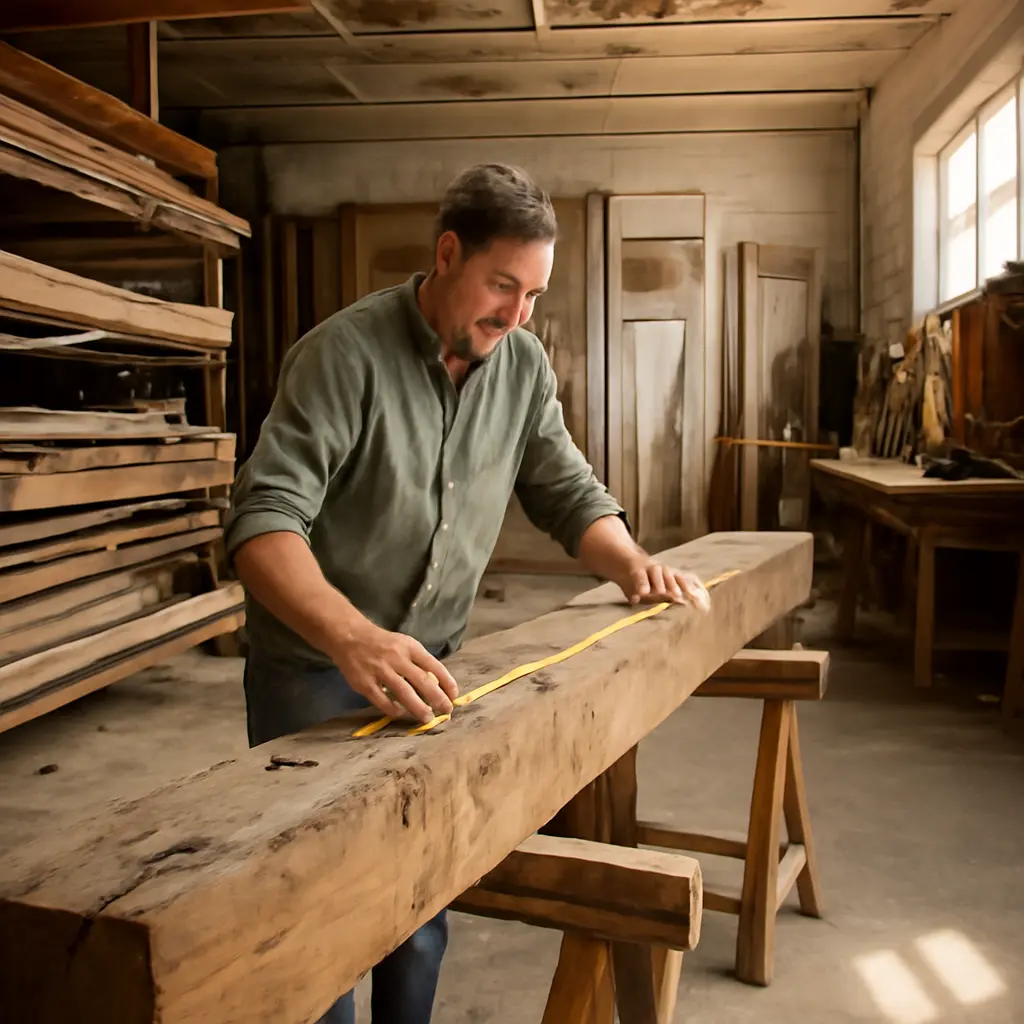
A practical example is a workshop commissioned to make a dining table from joists recovered from a local warehouse. Before removal, the craftsperson should confirm the wood’s dimensions and quantity, inspect for damage and contamination, agree on who pays for extraction and transport, and record the building’s history if it is relevant to the finished piece. This early coordination helps prevent a common problem: obtaining attractive material that proves too damaged, too short, or too costly to prepare.
Provenance, grading, and purchase decisions
Provenance is the documented history and origin of a material. It can include the building or product it came from, approximate age, prior use, species or composition, and any treatment or repair history. Provenance is particularly valuable for historic components, but a seller’s description should not substitute for an independent condition assessment. Craftspeople should also check title or ownership, especially when materials come from active job sites or publicly owned buildings.
Assessment usually considers dimensions, moisture, cracks, corrosion, fastener holes, warping, surface coatings, and the work needed to make the item safe and serviceable. Buyers should calculate the usable yield rather than comparing only the purchase price: a low-cost beam may require extensive metal removal, milling, drying, or disposal of unusable sections. A useful project chart would compare source, quantity, condition, preparation hours, transport cost, and expected usable yield for each candidate material.
Restoring reclaimed materials: inspection, treatment, and adaptation
Restoration is the process of stabilizing and preparing a used material for a new purpose while retaining useful qualities, character, or historic evidence. It is not simply cleaning: professionals decide what to preserve, what to repair, and what must be removed to meet safety and performance requirements. The Secretary of the Interior’s Standards for the Treatment of Historic Properties emphasize that preservation work should respect a property’s historic character and avoid unnecessary damage. For craft projects, the same principle supports restrained intervention—retain sound material where practical, but do not romanticize defects that create hazards.
Inspection and hazard screening
Inspection identifies structural defects, pests, moisture damage, hazardous coatings, and residues before material enters a workshop. Wood may need checks for rot, insect activity, embedded nails, and unknown chemical treatment; metal may require assessment for corrosion, lead-based paint, or unstable coatings; stone and masonry need checks for cracking, salts, and incompatible mortar. When a material’s history is uncertain, a qualified inspector or laboratory can help determine whether testing is warranted.
Lead is a particular concern in older painted components. The U.S. Environmental Protection Agency’s Renovation, Repair and Painting Rule generally applies to paid renovation work disturbing painted surfaces in pre-1978 housing and child-occupied facilities, subject to the rule’s conditions and exemptions. Craftspeople should follow applicable federal, state, and local requirements, use suitable containment and protective practices, and avoid dry sanding or other methods that create uncontrolled dust. Suspected asbestos-containing materials should be assessed and handled by qualified professionals rather than casually removed in a workshop.
Cleaning, repair, and stabilization
Cleaning removes dirt, residues, and loose finishes without damaging the material or spreading contaminants. The appropriate method depends on composition and condition: dry brushing or HEPA-filtered vacuuming may suit some surfaces, while other materials require controlled washing or specialist treatment. Before applying solvents, heat, or abrasive tools, professionals should test a small area and consider ventilation, fire risk, and waste disposal.
Repair and stabilization restore usable strength while preserving as much sound material as possible. A craftsperson might consolidate a split timber, replace a small section of decayed wood, straighten a metal fitting, or repoint masonry with a compatible mortar. For furniture and architectural work, reversible or minimally invasive repairs can be preferable when historical value is significant. The appropriate standard depends on the new use: a decorative panel and a load-bearing beam do not require the same performance assessment.
Drying, machining, and finish selection
Preparation brings reclaimed material to dimensions and moisture conditions suitable for its intended use. Recovered wood may need metal detection, nail removal, careful milling, and controlled drying or acclimation to reduce movement after installation. Because reused boards can vary in species, grain, age, and moisture, professionals often machine conservatively and retain extra stock for defects or joinery adjustments.
Finishes should be selected for compatibility, durability, and the material’s future use. A finish can protect a surface, but it may also conceal evidence of age or complicate later repair. Craftspeople typically test coatings on offcuts or inconspicuous areas, record the products used, and follow manufacturer instructions for ventilation, curing, and disposal. Where a component will be used in a regulated building application, appearance alone is not enough: fire performance, structural capacity, and other applicable code requirements may need professional verification.
Professional standards, sustainability, and project constraints
Responsible reuse balances material conservation with safety, function, and transparent communication. A reclaimed component is not automatically sustainable simply because it is old: transport, intensive processing, short service life, or hazardous treatment can undermine its benefits. The strongest decisions consider the whole project, including the material’s likely service life, the energy and labor needed for preparation, and what would otherwise happen to the component.
Code compliance and appropriate use
Building codes and product standards apply according to the component’s new use and location, not merely its age or reclaimed status. A salvaged door used as furniture has different requirements from a door installed in a fire-rated corridor; a decorative timber beam differs from one expected to carry structural loads. Where structural or life-safety performance matters, craftspeople should consult the building official, architect, engineer, or other qualified professional and retain relevant inspection and testing records.
Environmental value and limits
Direct reuse can extend the service life of a product and reduce demand for newly manufactured replacements. It may also retain embodied labor and distinctive workmanship, particularly in old-growth lumber, handmade brick, or historic fittings. However, there is no single environmental benefit figure that applies to every reclaimed item: results depend on what is reused, what new product it displaces, how far it travels, and how much repair it needs. The EPA’s debris data provide context for the opportunity, but do not quantify the life-cycle savings of an individual craft project.
A well-documented case study can compare two otherwise similar project options: a newly manufactured component and a reclaimed one. The comparison should state the material quantities, transport distances, preparation inputs, expected service life, and disposal route. This transparent approach is more useful than claiming a generic percentage reduction without project-specific evidence.
Documentation and client communication
Documentation records where a material came from, what condition it was in, what treatment it received, and what limitations remain. It can include photographs, supplier receipts, test results, repair notes, finish products, and care guidance. For clients, clear disclosure helps set expectations: reclaimed materials may show variation, old repairs, tool marks, or changes in color, and matching additional stock later may be difficult.
A professional workflow is therefore both a craft process and a traceability process. A shop that maintains a basic intake record and inspection checklist can make safer decisions, price labor more accurately, and provide clients with a credible account of the finished work.
Conclusion: sourcing and restoring with care
Professional craftspeople source reclaimed materials through salvage markets, direct recovery, and reuse networks, then judge each item by provenance, condition, usable yield, and suitability. Restoration involves hazard screening, careful cleaning, repair, stabilization, and preparation for the material’s next use. EPA figures—600 million tons of U.S. construction and demolition debris generated in 2018—underscore the scale of the resource opportunity, while also reminding us that recovery must be distinguished from direct reuse.
For clients and makers, the practical next step is to ask suppliers about origin and treatment, inspect materials before committing, and document the work required to make them fit for purpose. When structural or hazardous-material questions arise, bring in qualified specialists. Thoughtful reuse can preserve skilled workmanship and reduce waste, but its broader value depends on honest evidence, safe practice, and durable design.
Sources: U.S. Environmental Protection Agency, “Construction and Demolition Debris: Material-Specific Data,” https://www.epa.gov/facts-and-figures-about-materials-waste-and-recycling/construction-and-demolition-debris-material; National Institute of Building Sciences, Whole Building Design Guide, “Building Materials Reuse,” https://www.wbdg.org/resources/building-materials-reuse; U.S. Department of the Interior, National Park Service, “The Secretary of the Interior’s Standards for the Treatment of Historic Properties,” https://www.nps.gov/orgs/1739/secretary-standards-treatment-historic-properties.htm; U.S. Environmental Protection Agency, “Renovation, Repair and Painting Program,” https://www.epa.gov/lead/renovation-repair-and-painting-program